


This project involved building an MVP platform for Equip Flow, a private B2B procurement tool designed for the construction industry. Rather than operating as an open marketplace, the platform connects invited customers with suppliers and subcontractors through a structured requirement matching engine. Customers submit detailed procurement requirements, and the system generates a curated, ranked vendor shortlist based on predefined matching criteria. The platform was developed by TeamX as an invitation-only, admin-mediated system built to validate the end-to-end matching workflow before full-scale development.
Services
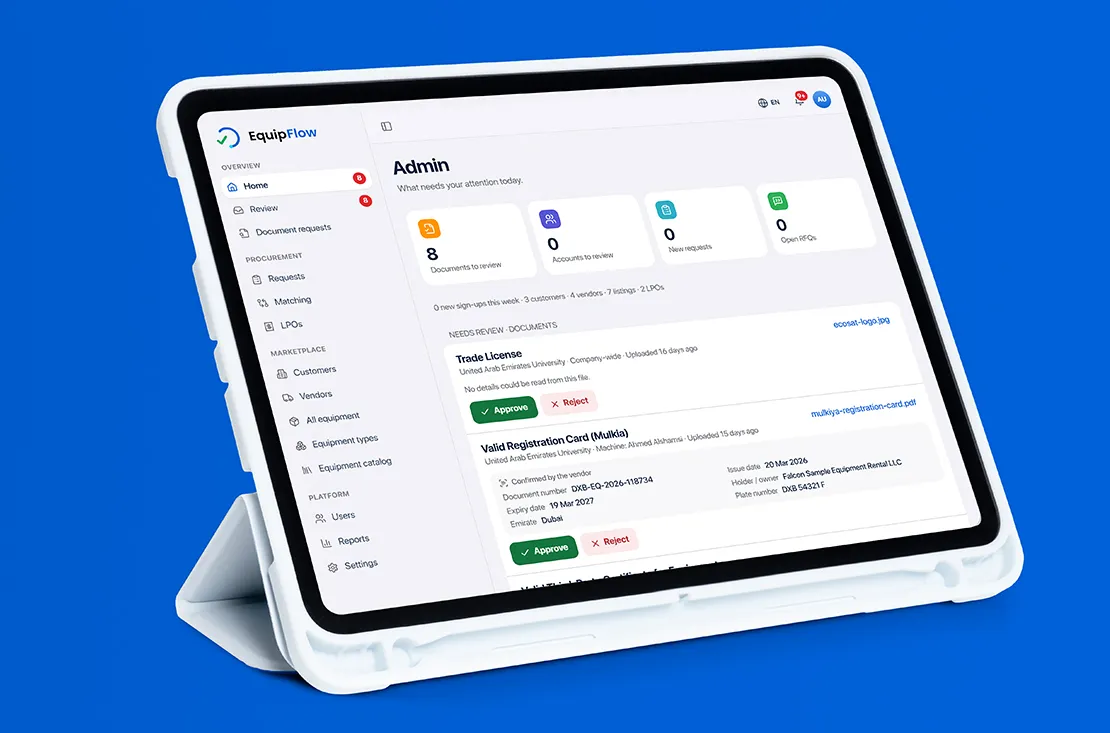
The core challenge was designing a matching engine that produces relevant results from structured input data rather than returning overly broad or irrelevant vendor lists. Each matching criterion carries a different weight in the final score, so calibrating those weights to reflect how construction buyers actually prioritise category fit, compliance status, budget range, and timeline required careful logic design. The compliance system added complexity: vendors needed to be matchable immediately after onboarding, before any documents were uploaded or reviewed, while the compliance status on the customer-facing vendor card still needed to reflect their actual verification tier accurately at all times. Protecting sensitive vendor documents while giving customers enough confidence to act required a clear visibility framework where customers see only the status indicator rather than the underlying files. Designing the LPO workflow within the platform also needed to be straightforward enough for construction industry users who may not be familiar with digital procurement tools.
The project was scoped and delivered as an MVP with a clear focus on workflow validation rather than feature depth. Work began with defining the four user roles and their permissions, then mapping the core workflows.
The matching engine logic was designed first, establishing the criteria weighting and scoring model that all other modules depend on.
The platform was built as a responsive web application accessible on desktop and tablet, structured around an invitation-only, admin-mediated access model. Role-based authentication enforced strict separation between Customers, Vendors, Admins, and Super Admins. Secure file storage was configured for vendor compliance documents with access restricted to admin users only. The matching engine was built on a weighted scoring model that normalises each vendor’s score to a percentage and ranks shortlists by relevance. An email-based notification system was integrated across all key workflow triggers, and a reporting module was built into the admin panel to track validation metrics.


